Ordering Without a Shared Language: A Field Checklist
Short questions, gesture-safe confirmation, and ingredient checks that still work when you share few words. Written for travelers with dietary limits who need clarity, not guesswork.
Clarity beats guessing from photos
When you share few words with a kitchen, the risk is not looking awkward — it is ordering something you cannot eat at all. Photo boards and pointing help, but they do not confirm oils, broths, nuts, dairy, or cross-contact. A short checklist keeps the exchange calm and specific even when vocabulary is thin.
This guide is for travelers with dietary limits and for anyone who wants fewer surprises. It assumes good faith on both sides of the counter and honest limits on what a busy kitchen can adapt. If a room cannot answer safely, leave. That decision is part of the skill.
“A nod is not a diagnosis. Confirm the ingredient, then confirm the preparation — in that order — before the plate leaves the pass.”
Think of the checklist as slowing the moment down. Speed is what creates false confidence. A thirty-second confirmation is cheaper than an evening lost to a preventable mistake.
Prepare before you reach the counter
Write your limits in the local language if you can, and keep an English line beneath. Short cards beat long speeches. Include what you must avoid and what happens if you eat it when the reaction is medical. Kitchen staff are not clinicians, but urgency words help them take the note seriously.
Choose rooms where you can see prep or speak to someone who cooks, not only someone who seats. Visibility improves confirmation. If everything is hidden and the answer is a shrug, treat that as data.
- List absolute avoids first, then preferences you can flex.
- Add one line asking which oil, broth, or sauce is used.
- Decide in advance what you will do if the answer is unclear — leave, or choose sealed packaged food.
- Keep the card readable in dim light; laminated notes survive market steam better than phone glare.
- Carry a second copy in a zip pocket in case your phone dies.
Test the card with a friend who does not know your diet. If they cannot restate your limits after one reading, rewrite. Clarity for a stranger is clarity for a busy cook.
Gesture-safe ordering at the pass
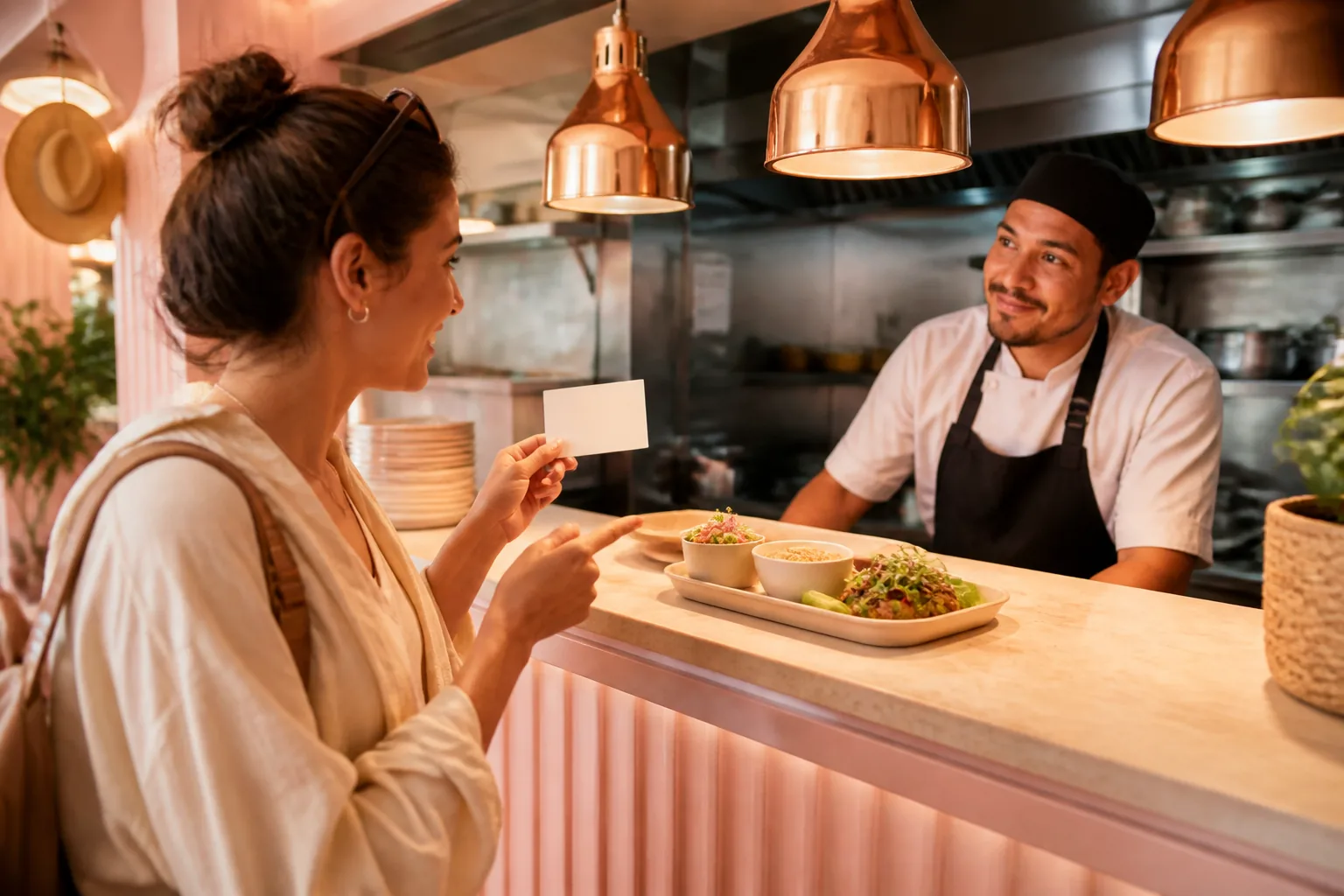
Point to a prepared tray when you can. Prepared food reduces improvisation. If you need a modification, ask one change at a time. Multiple changes in a rush increase error. Smile without rushing the confirmation — friendliness helps, but speed is not the goal.
- Point to the dish, then point to your card’s avoid list.
- Use a clear stop gesture for “without.”
- Ask to see the bottle or pot when oil or broth is uncertain.
- Repeat the key word you heard and wait for a second yes.
- If staff look unsure, thank them and choose another option.
- Do not crowd the counter with three overlapping voices.
Do not fake fluency. Mixed phrases and guessing create false confidence. It is better to be plainly limited and careful than to sound fluent and be misunderstood. Assign roles if you travel with companions: one speaks, one watches the pass, one holds the card.
Confirm ingredients, then confirm method
Many problems hide in method: fried in shared oil, simmered in meat broth, finished with butter, or dusted with nuts. After the main ingredient is cleared, ask how it is cooked. If you cannot ask in words, point to frying, boiling, or grilling icons you prepared, or show photos of the concern.
Separate “never” from “prefer not” on your card. Mixing them makes kitchens treat everything as optional. Hierarchy on the page becomes hierarchy in the reply. Include a line that invites a no: if they cannot do it safely, you want them to say so.
When the kitchen is too busy to adapt
Peak service is the worst time to request complex changes. If the room is slammed, choose a simple dish that needs little alteration, or come back later. Pressuring staff mid-rush raises the chance of a polite yes that does not match the plate.
For severe allergies, prefer kitchens that already cook within your limits rather than rooms that promise custom work under pressure. A smaller menu with clear answers often beats a long menu with hopeful improvisation.
Street counters and shared language gaps
Street stalls can be excellent and still hard to verify on the spot. Watch turnover, handwashing, and whether ingredients are handled in open view. Ask about sauces separately — they travel between trays. If you cannot confirm, skip the stall without drama. There will be another counter.
Carry a backup: fruit you washed, sealed snacks you trust, or a lodging kitchen plan. Backups reduce panic ordering when every conversation fails. Panic is when mistakes happen.
Children and older travelers need even clearer pacing. Build extra time so nobody feels pressured to accept an uncertain plate just to end the conversation. The checklist is a patience tool as much as a language tool.
After the plate arrives
Look before you eat. If something unexpected appears, stop and ask again. Sending a dish back is uncomfortable and still better than guessing. If communication collapses, do not eat the uncertain item. Pay if appropriate under local custom and leave calmly.
Note what phrasing worked. Over a trip, your card improves. Words that earned clear answers stay; words that caused confusion get replaced. That living checklist is more valuable than a generic phrasebook page you never revise.
When you eat well after a careful exchange, write what made it work: a visible kitchen, a quieter hour, a cook who answered, a single modification. Repeat those conditions. Ordering skill is pattern recognition as much as vocabulary.
Practice the checklist once on an easy meal before you need it for a high-stakes restriction. Muscle memory helps when you are tired. A calm first rehearsal makes later hard conversations shorter.
If you want help building phrasing sheets for a specific route and set of limits, request a consultation and bring your restrictions in plain language. We help you prepare questions you can verify on site — not promises that every kitchen can adapt.
Ordering without a shared language is slow on purpose. The pause is the safety feature. Travelers who refuse to rush confirmation eat with fewer emergencies and more trust in their judgment at the counter. Respect the kitchen’s limits as you respect your own. Finding a place that can answer honestly is a success, even if it means walking farther than the first glowing board.
Keep regional vocabulary updates in the same note as your avoids. When a word fails, replace it the same day. When a gesture works, keep it. Over a week of meals, the checklist becomes personal rather than generic — and that is when it starts protecting you reliably.
Remember that fatigue multiplies risk. If you are too tired to run the confirmation steps, choose sealed food or lodging cooking instead of improvising at a loud counter. The checklist only works when you have enough attention to use it. Rest is part of dietary travel safety, not a separate luxury.